
Homeowner guide
Leaking metal roof? What to check and when to call
A leak under a zinc, copper or other metal roof is worrying, but it is rarely the metal itself that has failed. Here is what to do straight away, what you can safely check from the ground and from inside, and when to ring us.
What to do straight away
Put a bucket or a towel under the drip and move anything that could be damaged. If water is coming through near a light fitting or a socket, switch that circuit off at the fuse box and leave it off until it has been checked.
Please stay off the roof, particularly in the wet. Everything in this guide can be checked from the ground, from a window or from inside the house, and the rest is our job.
What to check from the ground and from inside
A few minutes of looking before you call helps us find the leak faster. Take photographs as you go.
- Where the water shows. Note the room and the spot on the ceiling or wall. Water travels along the deck and the timbers, so the stain is very often nowhere near the hole, but it gives us a starting point.
- When it shows. Does it drip in every downpour, only when the rain is driven by the wind from one direction, or on dry days as well? That pattern tells us a lot before we arrive.
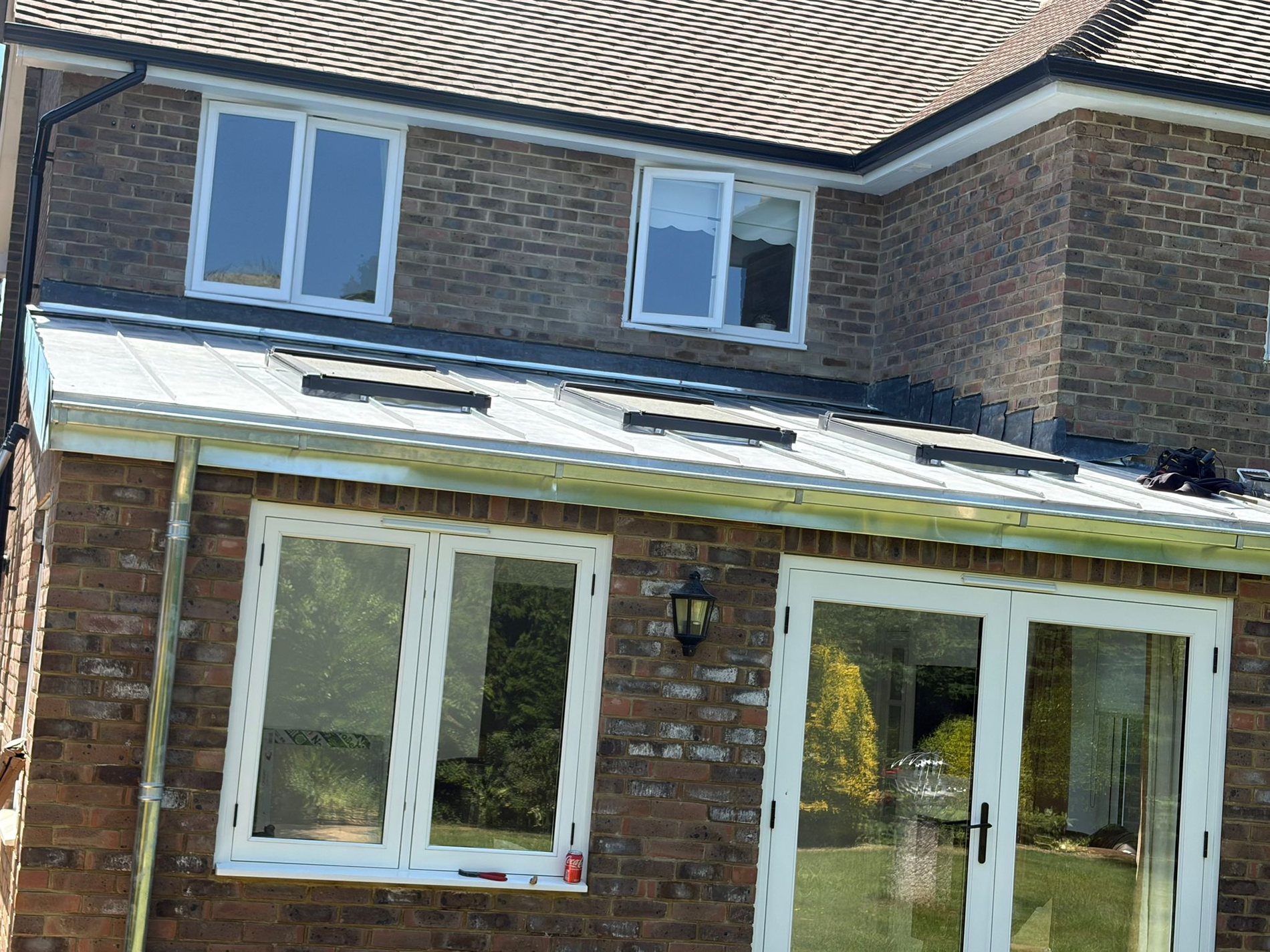
- What sits above it. Look for a chimney, a parapet wall, a dormer, a rooflight, a valley, or a spot where the roof meets a wall or the cladding. Those junctions are where most leaks start.
- Gutters and outlets. From the ground or a window, check whether the gutters and outlets near the leak are full of leaves or moss. Keeping gutters clear is the one bit of upkeep every metal roof needs.
- Recent work. Has anybody been on or near the roof lately? An aerial, a satellite dish, a new flue, building work next door or another roofer. Leaks often start where a later trade has cut through something they should not have.
- Storm or impact damage. After high winds, look from the ground for a lifted edge, a loose flashing or a fallen branch.
Where metal roofs usually leak
Most of the metal roof leaks we are called to are not failures of the metal. They are failures of a detail, and the same few details come up again and again:
- Seams and welts that were closed badly or have opened up
- Split or fatigued sheets on older roofs
- Upstands and abutments that were never high enough
- Chimney and parapet flashings that were dressed badly
- Valley and gutter linings
- Places where another trade has cut through the roof
Older copper roofs are often sound across the sheet, with the failures at the seams, upstands or flashings, which is why a well judged repair can often put a metal roof right.
New roofs can leak too. We also get called to new build work where a metal roof has been laid without the right equipment or training. That is fixable, though sometimes the honest answer is to take it off and start again.
Changes that are not a leak
Metal roofs change colour as they weather, and that can look alarming if you are not expecting it.
- Natural zinc weathers unevenly for the first few months, particularly where rain runs off more in one place than another. It evens out to a soft grey.
- Copper darkens to brown within the first year or two and, over decades, turns green. That green patina is not corrosion. It is a stable layer that protects the metal underneath.
- Copper run off can mark light stonework and render below it. That is a rainwater detail to sort out, not a hole in the roof.
Not sure whether what you are seeing is a fault? Send us a photograph and we will tell you.
When to call us
Call us as soon as water is coming in. A live leak gets a site visit as soon as we can manage, usually within the week. If it is urgent, ring rather than email.
Call us too if a stain keeps coming back after a patch, if the same leak has been chased before without success, or if the roof was fitted by somebody else. Most of our repair work is on roofs we did not fit.
We trace the leak from the inside as well as the outside before anybody starts cutting, and you get a written report with photographs. If it turns out to be something other than the roof, we will say so. If the roof genuinely needs replacing, we will show you why.
To see what the work itself involves, read about our metal roof repairs.
What to have ready when you ring
- Your photographs of the stain and of the roof from the ground
- Roughly how old the roof is and who fitted it, if you know
- The metal, if you know it: zinc, copper, aluminium, stainless steel or lead
- An offcut, if one was left behind when the roof was fitted. It helps us match the system and the finish
- Whether your insurer is involved, for storm or impact damage
The details we check first
Click any photo to see it full size.
Frequently asked questions
Why is the stain on my ceiling nowhere near the damage on the roof?
Water travels. It can run along the deck and the timbers for some distance before it shows, which is why so many metal roof leaks get patched in the wrong place. We trace it from the inside as well as the outside before anybody starts cutting.
Should I go up on the roof to look?
No. Please stay off the roof, especially when it is wet. Photographs from the ground or from a window are all we need to get started, and we will do the close inspection.
Does a leak mean the whole roof needs replacing?
Not usually. Most leaks we are called to come from a detail such as a seam, an upstand or a flashing rather than the metal itself, so a repair will often do. If the roof genuinely is finished, we will show you why with photographs.
My new zinc roof has gone patchy. Is it leaking?
Patchiness on its own is not a leak. Natural zinc weathers unevenly for the first few months and then evens out. If you also have water coming in, ring us and we will find where it is getting in.
Can you fix a leak on a roof another firm fitted?
Yes, and that is most of our repair work. We work on zinc, copper, aluminium, stainless steel and lead roofs, whoever fitted them.
Do you take on insurance work for storm damage?
Yes, we take on insurance work for storm and impact damage, and our reports are written with photographs.
How quickly can you get to a leak?
A live leak gets a site visit as soon as we can manage, usually within the week. If it is urgent, ring rather than email. We reply to every enquiry within one working day.
Tell us about the leak
We reply within one working day. If water is coming in now, ring 07827 915194.

Thinking about a metal roof?
Send over a few details and we will come out, get on the roof and tell you honestly what it needs.
Our work is on
The British Museum
Great Ormond Street Hospital
The British Library